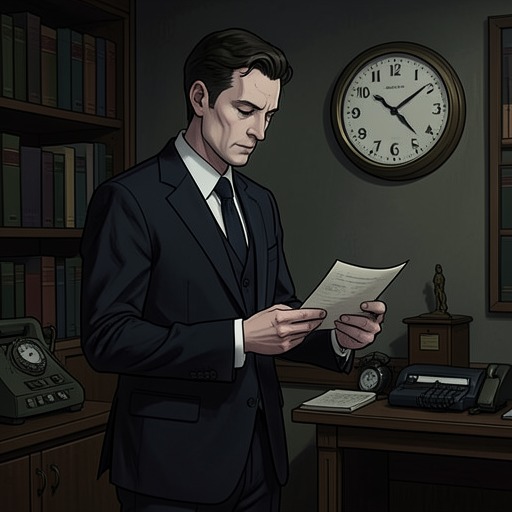
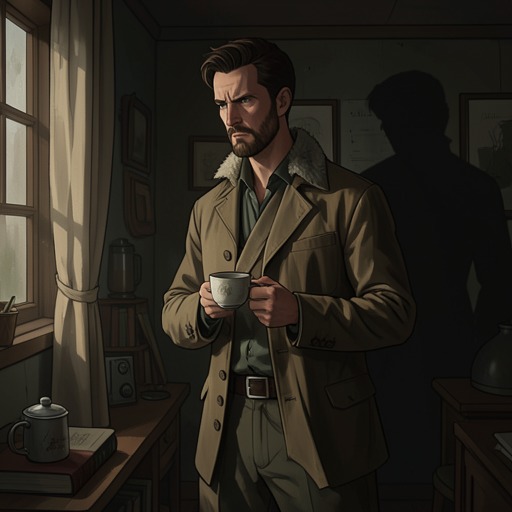
Patrick’s journal
My PolicemanPatrick Hazlewood’s journal is a private record of desire written under the pressure of secrecy. In entries dated 29 and 30 September 1957, Patrick announces that he has met someone, describes the caution that makes writing dangerous, and then confronts his wish to preserve the new attachment in words. The journal’s central tension is material and emotional at once: paper can expose what must remain hidden, but destroying it would erase one of the few records through which Patrick can confirm his own experience.
A record made under threat
The 29 September entry opens by asking why Patrick should write again when he knows that setting down his desires is dangerous. His warning is not abstract. He describes people who loudly harass others in public, recalling that he saw Gilbert Harding shout from a car window at a young man on a bicycle. The incident leaves him unsure whether to laugh or cry, and it gives his concern about indiscretion a social setting: attention can be aggressive, public, and humiliating. Patrick does not treat the journal as harmless self-expression. He knows that another person might read it, and that its contents could expose what he has chosen not to name.
Against this caution, the entry declares that things have changed and that Patrick has met someone. He withholds the person’s name, presenting that omission as prudence rather than a failure of feeling. Indeed, he calls the man perfect and ideal, while insisting that the attraction is more than physical. His account therefore records an imbalance between what can be stated and what must be protected: Patrick can write of the strength of his response, but not identify its object. The journal lets him approach disclosure while stopping short of public knowledge.
Patrick also places this new attachment against his limited history of affairs. They have been few, complicated, and prolonged; by contrast, the encounters associated with Charlie and the young men at the meat rack seem carefree or fleeting. Patrick does not simply dismiss those brief encounters as sordid. He recognizes their beauty as well as their brevity, but distinguishes them from the importance he now gives this particular connection. That contrast helps explain why he writes despite the danger: this is not, in his account, another passing episode.
The first entry and its scene
After announcing the meeting, Patrick recounts a morning on Marine Parade when a cream Ford nudges a bicycle and carries on, leaving its rider sprawled on the pavement. Patrick hurries to help the woman, who is sitting up by the time he reaches her. Her bicycle is burdened with bags of different kinds, and Patrick touches her shoulder to ask whether she is all right. The scene begins with an ordinary act of assistance, observed in precise particulars: the car’s color, the approximate time, the quiet late-summer morning, and the rider’s tangled position beside the bicycle.
That carefully observed accident sits beside the entry’s guarded declaration of a new attachment. The journal thus holds together public encounter and private feeling without making them equivalent: the woman on the pavement is the person Patrick helps, while his unnamed new attachment is introduced as a separate disclosure. The exactness of the recollection also contrasts with his refusal to give a name. Patrick records circumstances closely, but controls what those circumstances are allowed to reveal. His account makes the journal both a witness to events and an instrument of selective disclosure.
The impulse to destroy and preserve
Patrick ends the 29 September entry by saying he will burn it after writing. The threat makes the act of recording provisional: the journal is useful only so long as it remains private, and its physical destruction appears to offer protection from unwanted readers. Yet the following entry, dated 30 September, turns that intention into a conflict. Patrick has not slept and has repeatedly thought of burning what he wrote, but cannot bring himself to do so. Without the words, he asks, how can he make the new man’s presence—and his own feelings—real to himself?
The next day’s reflection broadens the problem beyond this one entry. Patrick regards writing as a bad habit and sometimes a poor substitute for living. Each year he clears things out by burning them; he has already destroyed Michael’s letters and now regrets doing so. That regret gives the threatened destruction of the journal a history and a consequence. The private record is not merely incriminating material to be removed: it may become the surviving evidence of an attachment otherwise denied or lost. Patrick’s inability to burn the page registers the force of that possibility without resolving the danger that made him want to destroy it.
Michael, memory, and the new attachment
Patrick connects his response to the new man with an earlier loss. Five years after Michael was lost, Patrick says he will not permit himself the luxury of remaining in the dark room of grief. He distinguishes the new man from Michael and identifies that difference as one of the reasons he loves him. The contrast does not erase the earlier relationship; instead, it shows Patrick trying to recognize the new attachment on its own terms while guarding against a return to an old sorrow.
By the end of the 30 September entry, Patrick’s description has shifted from danger and sleeplessness toward lightness: the words that come to mind for his policeman are light and delight. The journal does not resolve the conflict between secrecy and expression. It makes that conflict its form. Patrick records what he fears another person might discover, considers destroying the evidence, and then keeps writing because the words help him trust that the feeling and the person are real. In this way, the journal preserves a beginning while also exposing how precarious preservation is.